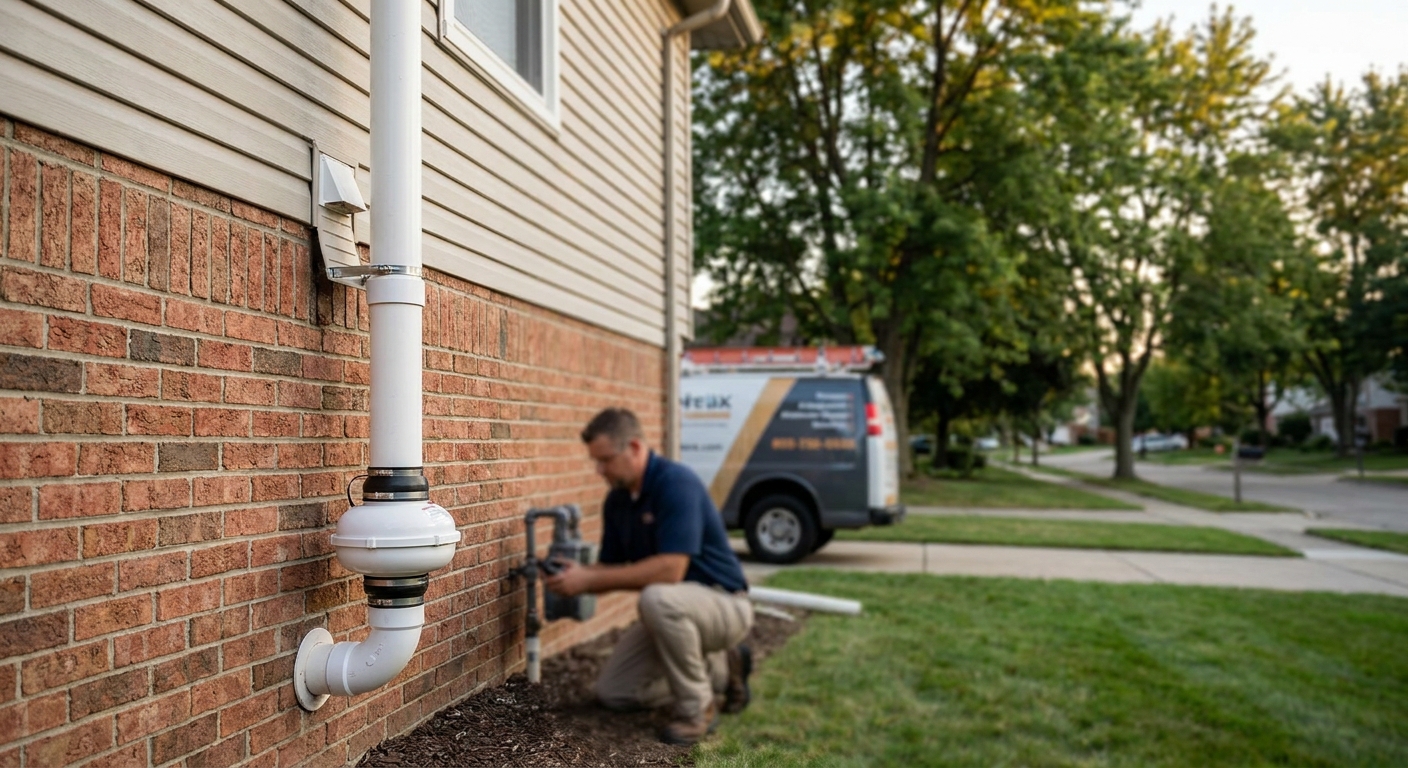
Novi sits in Oakland County, one of the highest-radon regions in Michigan, and the mitigation system that works for your neighbor's ranch on a slab may be the wrong call for your tri-level with a walkout basement. This guide breaks down what actually matters when you're buying radon mitigation for your Novi home in 2026.
- Sub-slab depressurization is the standard radon mitigation Novi MI homes with basements need — Buy.
- Crawl space homes need submembrane suction, not a basement-style SSD system — Consider.
- EPA's action level is 4 pCi/L, and Oakland County averages above that in many subdivisions.
- NRPP-certified installers back systems with a 5-year warranty as of 2026.
- Passive builder-installed stacks in newer Novi homes often need a fan retrofit to actually work.
Why this matters
Oakland County falls inside EPA Radon Zone 1, the designation for counties where predicted average indoor screening levels exceed 4 pCi/L. That's not a scare number — it's the EPA action threshold, and it's the line every mitigation system in Novi is built to get you under. Glacial till soil, common across southeast Michigan, traps and channels radon gas up through foundation cracks, sump pits, and drain tile far more efficiently than sandy soil does elsewhere in the state.
Homes built in Novi from the 1980s through the 2000s cover three foundation types: full basements, crawl spaces, and slab-on-grade. Each one moves soil gas differently, so the mitigation system that pulls a basement down to 1 pCi/L can leave a crawl space untouched. Getting this match wrong is the single biggest reason a mitigation system underperforms after installation.
Who this is for
This guide is for Novi homeowners who tested above 4 pCi/L, buyers closing on a home with a radon result in that range, and realtors managing a transaction where mitigation is a contingency. If you're still deciding whether to test, Michigan Radon Control runs NRPP-certified testing across Metro Detroit, and the result determines everything that follows in this guide.
What to look for in radon mitigation for Novi homeowners
Foundation type match
A basement, a crawl space, and a slab each need a different suction point, and a contractor who defaults to one system regardless of foundation is cutting corners. Ask specifically how the system will address your foundation type before signing anything.
NRPP certification
National Radon Proficiency Program certification means the installer follows EPA-consistent protocols for pipe sizing, fan selection, and sealing. In a market with glacial till soil like Oakland County's, an under-sized fan is the most common reason a system fails to hold levels under 4 pCi/L.
Post-mitigation retest included
A system installed without a follow-up test is a guess, not a result. Confirm the retest happens 24 to 48 hours after fan activation and that the number gets handed to you in writing.
Warranty length
A 5-year warranty on parts and labor is the standard to expect in 2026. Anything shorter signals the installer isn't confident in the fan or the seal work holding up through a Michigan winter.
Fan noise and placement
Fans mounted in living spaces or attics run quieter than garage or exterior mounts, but garage and exterior placements are easier to service. For homes with finished basements, ask where the fan sits before installation day, not after.
Soil and system capacity
Glacial till compacts tighter than sandy soil, which means Novi systems often need a higher-capacity fan than the same square footage would require in a sandier part of the state. This is where foundation type and soil type intersect, and it's why a generic quote without a site visit is a red flag.
Top picks by foundation type
Sub-slab depressurization (SSD) — the standard pick. One 3- to 4-inch PVC pipe runs from a sealed suction point under the slab to a roof-mounted fan pulling 130+ CFM. This handles the majority of Novi basements built on poured concrete. Buy.
Sump-hole depressurization — the efficient pick. The suction point uses your existing sump pit lid instead of cutting new slab, which cuts install time and cost for homes that already have a sump pump. Buy if your sump lid can be sealed airtight.
Drain-tile suction — the wildcard. Homes with a full perimeter drain-tile loop can route suction through that existing network instead of a new penetration. It works well but depends on the drain tile being continuous and undamaged. Consider, and ask for a smoke test first.
Block-wall (submembrane) suction — the crawl-space specialist. Crawl spaces need a heavy plastic membrane sealed to the foundation walls with suction pulled from beneath it, not a basement-style slab penetration. Homes similar to those covered in radon mitigation systems for Livonia homes use this same approach for crawl-space foundations. Consider for any Novi home without a basement.
Passive stack upgrade — the one to check first. Many Novi subdivisions built after Michigan adopted radon-resistant new construction codes shipped with a passive stack: a pipe and vapor barrier with no fan. Passive-only systems frequently test above 4 pCi/L because there's no active suction. Skip relying on a passive stack alone — get it tested and add a fan if the number comes back high.
Get your Novi home tested
NRPP-certified testing and mitigation across Oakland County, backed by a 5-year warranty.
What to avoid
- Sealant-only fixes. Caulking cracks reduces some entry points but does nothing to address soil gas pressure — it's not a substitute for active depressurization.
- Contractors without a site visit. A phone quote for radon mitigation without seeing your foundation type is a guess, not an estimate.
- Skipping the post-install retest. A system that isn't verified with a follow-up test is unproven, regardless of what the installer promises.
If you're scheduling installation, how to prepare your home for a radon mitigation system covers what needs to be cleared from the basement or crawl space before the crew arrives.
Verdict comparison
| System | Best foundation | Install time | Verdict |
|---|---|---|---|
| Sub-slab depressurization | Basement, poured slab | 1 day | Buy |
| Sump-hole depressurization | Basement with sump pump | Under 1 day | Buy |
| Drain-tile suction | Basement with perimeter drain tile | 1 day | Consider |
| Submembrane suction | Crawl space | 1 day | Consider |
| Passive stack alone | New construction, untested | N/A | Skip without retest |
FAQ
What's the best radon mitigation system for a Novi MI home with a basement?
Sub-slab depressurization is the standard fix for Novi basements, using a sealed suction point under the slab and a roof-mounted fan. Homes with an existing sump pit can often use sump-hole depressurization instead, which cuts install time.
Is radon mitigation required to sell a home in Novi, Michigan?
Michigan doesn't mandate radon testing or mitigation for a home sale, but many purchase agreements include a radon contingency once a test comes back above 4 pCi/L. Buyers frequently request mitigation as a condition of closing.
How long does radon mitigation installation take?
Most residential systems install in a single day, including sub-slab, sump-hole, and submembrane crawl space systems. A retest 24 to 48 hours after the fan is activated confirms whether the level dropped below 4 pCi/L.
Do crawl space homes in Novi need a different system than basement homes?
Yes. Crawl spaces need a sealed vapor membrane with suction pulled from beneath it, while basements use a sub-slab or sump-hole suction point instead. Using a basement-style system on a crawl space typically fails to reduce levels.
What radon level is considered dangerous in Michigan?
The EPA sets 4 pCi/L as the action level at which mitigation is recommended nationwide, including in Michigan. Oakland County, where Novi sits, falls into EPA Radon Zone 1, meaning average indoor screening levels commonly exceed that threshold.
How often should a radon mitigation system be retested?
A retest immediately after installation confirms the system is working, and most homeowners retest every two years afterward. Retesting after any foundation repair or major renovation is also recommended since sealing changes can affect suction.
Is Oakland County a high-radon zone?
Yes, Oakland County is classified EPA Radon Zone 1, the highest-risk category, largely due to glacial till soil common across southeast Michigan. This soil type traps and channels radon gas more than sandy soil found elsewhere in the state.
Can a passive radon system in a new Novi home be trusted without testing?
No. Passive stacks installed under Michigan's radon-resistant new construction code lack a fan, so they rely on natural pressure differences that often aren't enough. Testing the home and adding a fan if levels exceed 4 pCi/L is the only way to confirm the system works.
One last thing
Most homeowners assume a newer Novi build is safer because it has a passive radon stack built into the code-required construction. In practice, that passive pipe without a fan attached frequently tests above the 4 pCi/L action level, because it depends on stack effect and wind pressure instead of active suction. If your home has one of these stacks and you've never had it tested, that's the first call to make in 2026, not the last.