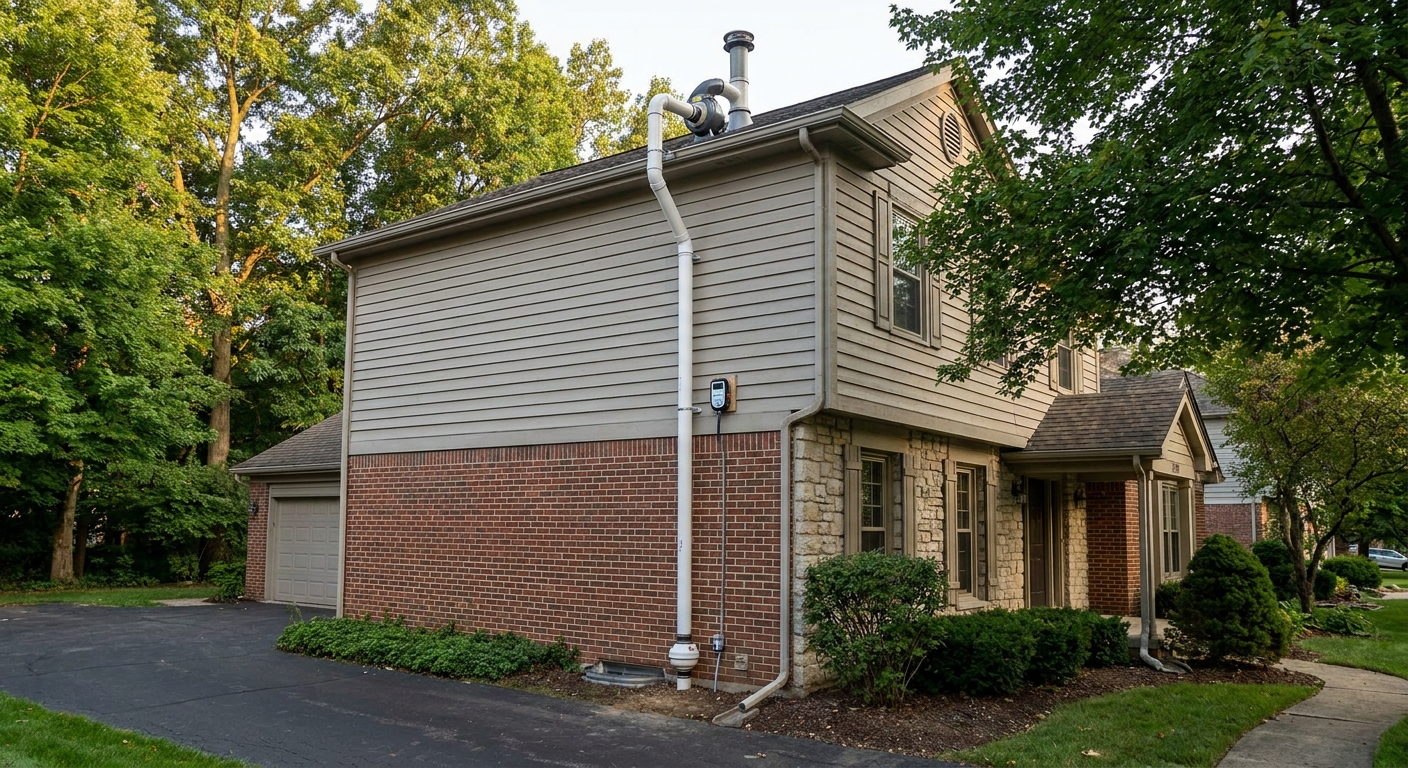
Farmington Hills sits on the same glacial till that pushes radon levels above the EPA action level across much of southeast Michigan, and a colonial with a poured basement needs a different fix than a ranch with a crawl space. This guide breaks down which radon mitigation system fits which foundation, what a real installation costs in effort (not corner-cutting), and which system type to skip.
- Sub-slab depressurization is the right call for most Farmington Hills basements and typically brings levels below the EPA action level of 4.0 pCi/L.
- Homes with a sump pit often qualify for sump-hole suction, a lower-disruption install than drilling new slab penetrations.
- Hollow block foundation walls need block wall suction, not a standard sub-slab system, or radon keeps re-entering through the wall cavities.
- Skip any installer who won't put a manometer on the system or won't run a post-mitigation test.
- Michigan Radon Control installs NRPP-certified systems for Farmington Hills homes with a 5-year warranty.
Why this matters
Radon is a naturally occurring gas that seeps up through soil and foundation cracks, and the EPA sets 4.0 pCi/L as the action level where mitigation is recommended. Michigan's glacial soils and fractured bedrock push a large share of Oakland County homes above that line, which is why testing before or during a home sale in Farmington Hills so often turns up a result that needs a system, not just a retest.
The fix is well understood engineering, not guesswork. A properly sized fan and pipe network can pull sub-slab levels down within 24 hours of activation, but only if the system type matches the foundation. Installing the wrong type is the most common reason a Farmington Hills mitigation job underperforms in 2026, and it's an avoidable mistake if you know what to check before signing a contract.
Michigan Radon Control installs and services all four standard system types across Metro Detroit, including Farmington Hills, so the comparison below reflects what actually gets specified on local jobs, not a generic national list.
Who this is for
This guide is for Farmington Hills homeowners who've had a test come back above 4.0 pCi/L, realtors preparing a listing for inspection, and buyers negotiating mitigation as a condition of closing. If you haven't tested yet, do that first — everything below assumes you already have a number to act on.
What to look for in radon mitigation systems for Farmington Hills homes
NRPP certification on the installer
Radon mitigation is not a general contractor task. An NRPP-certified installer follows EPA-consistent design standards for pipe sizing, fan placement, and sealing, and that certification is what a home inspector or buyer's agent will ask to see during a Farmington Hills closing.
A system matched to your foundation type
A poured basement, a block foundation, and a crawl space each pull radon differently, and a system designed for one won't perform on another. This is the single biggest driver of a failed post-mitigation retest, more than fan size or pipe diameter.
Fan placement and noise
Fans mount outside or in an attic, never inside living space, and a correctly sized fan for a typical Farmington Hills home runs quietly enough that most homeowners forget it's on. A fan that hums audibly from inside the house is usually undersized or mounted wrong.
A manometer and post-install test
Every active system needs a U-tube manometer showing suction is present, and every install should end with a post-mitigation radon test confirming levels are below 4.0 pCi/L. Skip either of these and you're trusting the installer's word instead of a measurement.
Warranty length
A 5-year warranty on parts and labor is a reasonable standard for a Farmington Hills install in 2026 — anything shorter suggests the installer isn't confident in the design.
Local permit and code compliance
Farmington Hills and Oakland County require permitting on mitigation installs tied to structural or electrical work. An installer who skips the permit step is cutting a corner that shows up later during a home sale.
Get your Farmington Hills home tested
NRPP-certified testing and mitigation with a 5-year system warranty.
Top picks: which system fits your foundation
Sub-slab depressurization — the standard pick. This is the system specified on most poured-basement homes in Farmington Hills, and it works by drilling a single suction point through the slab and running PVC pipe to an exterior fan. It typically pulls sub-slab levels below 2 pCi/L within a day of activation. Verdict: Buy for any basement home with a continuous concrete slab.
Sump-hole suction — the low-disruption fix. If your basement already has a sump pit, sealing the pit lid and tying suction into it skips new slab penetrations entirely. It's faster to install and leaves less patching work than a fresh sub-slab point. Verdict: Buy if you already have a sump pump and a sealable pit lid.
Drain tile suction — the efficient retrofit. Homes with an interior drain tile loop around the footer can use that loop as the suction path instead of drilling new holes. It's an efficient option when the loop runs the full perimeter, but it underperforms in homes where the tile only covers part of the foundation. Verdict: Consider, and confirm loop coverage before committing.
Block wall suction — the specialist fix. Hollow block foundation walls let radon travel sideways through the block cavities, which a standard sub-slab system won't capture. This system draws suction from the wall cavities themselves, usually paired with a sub-slab point for full coverage. Verdict: Buy only if your foundation has hollow block walls — otherwise it's unnecessary cost.
What to avoid
- A single suction point on a home over 2,000 square feet with a divided slab. Larger or sectioned foundations often need a second suction point, and one point alone won't pull the whole slab down below 4.0 pCi/L.
- A system with no manometer. If you can't see suction is present at a glance, you have no way to know the system is still working next year.
- Skipping the post-mitigation test. A mitigation contractor who installs and leaves without confirming the number dropped is skipping the one step that proves the job worked.
Before any crew shows up, it helps to prepare your home for a radon mitigation system — clearing basement access points and identifying your foundation type in advance shortens the install day.
“If a mitigation system doesn't include a manometer, you have no way of knowing whether it's still working next year.”
Verdict comparison table
| System type | Best foundation match | Install complexity | Verdict |
|---|---|---|---|
| Sub-slab depressurization | Continuous poured basement slab | Moderate — one to two slab penetrations | Buy |
| Sump-hole suction | Basement with existing sump pit | Low — seals existing pit | Buy |
| Drain tile suction | Full-perimeter interior drain tile | Low to moderate | Consider |
| Block wall suction | Hollow block foundation walls | Moderate to high | Buy for block foundations only |
FAQ
What is a safe radon level for a Farmington Hills home?
The EPA sets 4.0 pCi/L as the action level where mitigation is recommended, and levels above that warrant a system in 2026. Many mitigation professionals aim to bring levels below 2 pCi/L for extra margin.
How much does radon mitigation cost in Farmington Hills, MI?
Cost depends on foundation type and system complexity, with sub-slab and sump-hole systems generally less expensive than block wall or multi-point installs. Get a site-specific estimate rather than relying on national averages, since Michigan foundations vary widely.
How long does radon mitigation installation take?
Most single-point sub-slab or sump-hole systems install in a single day. Homes needing block wall suction or multiple suction points can take longer depending on foundation layout.
Do I need a permit for radon mitigation in Oakland County?
Yes, Farmington Hills and Oakland County require permitting on mitigation work tied to electrical or structural changes. An NRPP-certified installer handles this as part of the job.
Is sub-slab depressurization better than sump-hole suction?
Neither is universally better — sub-slab depressurization suits homes without a sump pit, while sump-hole suction is faster and less disruptive when a sealable pit already exists. The right choice depends on your foundation, not a general ranking.
How do I know if my radon mitigation system is still working?
Check the manometer for continuous suction reading and retest radon levels periodically, especially after 2026 seasonal freeze-thaw cycles that can shift foundation seals. A system with no manometer gives you no way to confirm it's active.
Can I install a radon mitigation system myself?
DIY installs are not recommended because system type, pipe sizing, and fan placement all affect whether radon levels actually drop below 4.0 pCi/L. An NRPP-certified installer designs the system to the specific foundation.
Does radon mitigation affect a home sale in Farmington Hills?
Yes, radon test results above 4.0 pCi/L commonly become a negotiation point in Farmington Hills closings in 2026, and a documented, warrantied system with a passing post-mitigation test resolves the issue for buyers and their agents.
One last thing
The detail most homeowners miss: a mitigation system installed for one foundation section doesn't automatically cover an addition or a finished crawl space added later. If your Farmington Hills home has had an addition built since the original system went in, that section may need its own suction point — worth checking on the next manometer inspection rather than assuming the whole house is covered.